
What the astrology community is living through right now, and what the South Node in Leo is actually asking of us
You know the feeling before you have a name for it.
Someone whose books are on your shelf, whose method you learned, whose language you have probably used in a client session without crediting because it has been part of how you think for years, does something you cannot defend.
And the first thing that goes is not your opinion of him. The first thing that goes is your self-trust.
Because if you were wrong about him, what else are you wrong about? And that question does not stay where you put it. Within about a week you are looking at every other name you have elevated, every teacher you have quoted, every person whose word you took because of who they were rather than because you checked, and you are thinking: and you? Are you what I thought you were?
What I did not see coming was the audit that follows a fall like this.
If you work with the sky, the timing will not surprise you. In late July the South Node moved into Leo, the sign of the single shining star, and the North Node into Aquarius, the sign of the collective. For the next eighteen months, how we elevate people, and how we bring them down, is the work.
What Actually Happened
On 23 July, on the Lila Astrology podcast with Ricky Williams, in a conversation about shadow work and racism, Steven Forrest said a racial slur in full.
What followed is on the public record, and I will stick to that record here. Later, I will also share my own experience of this time.
Astrology University removed him as faculty, pulled two of his lessons from its Professional Astrologer Diploma Program, and withdrew his webinars from sale. Teachers from his own school resigned. The United Astrology Conference said his participation was under review, and then its board withdrew him as a speaker, which cannot have been an easy call with the conference only weeks away. UAC ran in the first week of September without him.
His own public response, as Judith de Haan has documented, opened with “I am appalled and saddened by the upset my words have created. I apologize for my lack of judgement. Please consider the context.” It was set out under three headings: “The Accusation”, “The Reality” and “My Mistake”. He has since described himself as banished.
I have linked the sources in the text and at the bottom. Read them yourself rather than taking my summary, which is a small demonstration of the entire point of this piece.
The community did not land in one place. Some people called it abhorrent racism. Others called it a woke overreaction. Some explained it by his age, as an old man who no longer filtered what he said, and that drew its own pushback: that blaming his age was ageism dressed up as compassion. Every one of those positions has been written up, and if you have been anywhere near astrology social media since July you have watched people you respect end up on opposite sides of it.
So let me be clear about where I stand. Saying that word was incredibly harmful and blatantly wrong, no matter your age or upbringing or intent. It hurt Black astrologers most of all, including students who had trusted him. I can say that plainly without needing to decide what kind of person he is. Holding the act to account and tearing the person apart are not the same thing, and I think some in our field have started to forget the difference.
Then, Six Weeks Later, a Very Different Fall
Chani Nicholas started with a weekly astrology newsletter to friends and family in 2011. Fifteen years later she has a New York Times bestselling book, You Were Born for This, her own app, a weekly podcast, and an appearance explaining astrology on Netflix. She has taken astrology to an audience most of us will never reach.
At UAC itself, she was billed as the keynote and the session ran as an interview.
The response was hard. The most considered public version of it argued that it “was not a keynote it was an interview, one that she seemed unprepared for,” and that it “did not show any leadership capabilities, astrological knowledge, or an awareness of the state of the astrological community.” Others defended her in equally strong terms, pointing to her refusal to use AI-generated astrology, how she treats the people who work for her, and years of work that brought an enormous number of new people to astrology.
I am not going to tell you which of them is right.
Not because I do not have a view. I have several. I am not an avid follower of her work. I have enormous respect for what she has built as a business. And I detest the kind of public tearing down I have watched on Threads. Standing up at a conference to share your work takes real courage, whoever you are and however long you have been doing this. When a session does not land, we owe each other constructive feedback, not a pile-on.
Whether she gave a good keynote is not mine to assess, and I was not in the room.
What I will ask is the question underneath it, and it is the same question as the Forrest one wearing different clothes.
Who decides who is seen as an authority, and on what basis?
To UAC’s credit, it publishes how it chooses speakers, which is more than most of our field does. And what it reveals is not really about UAC at all. The biggest names are invited automatically, on the strength of how many of us came to their talks at recent conferences. Returning speakers are voted in by members. New speakers go through a committee.
For most of the line-up, the conference is not deciding who matters. It is reading our attendance and our votes back to us. We choose who belongs on the stage every time we choose which room to sit in.
The most considered criticism made specific points you can weigh. But much of the wider response reached past them for something vaguer: not a real astrologer. It is worth being honest about who that charge tends to find. In my experience of this field, it lands, over and over, on the astrologers who went mainstream without coming up the “right” way, and disproportionately on the women, the queer astrologers and the astrologers of colour among them. It rarely lands on a man with a long back catalogue and a devoted following.
Notice who the legitimacy question was never put to. Steven Forrest said what he said as a guest on a podcast posted publicly on YouTube, in a conversation about shadow work and racism, which is delicate work that needs real training and real care. I barely saw anyone ask whether he had either. His standing as an astrologer was never in doubt, so his competence at everything else came along with it, unexamined.
The Same Gap Underneath Both
I want to be careful here, because these two are not equivalent. One is a man who used a racial slur, and real harm to real people. The other is a woman who gave a session some people did not rate. What they share is not what happened. It is the system underneath both of them.
One is authority conferred by status and then insulated from consequence. Right up until it was not. The other is authority conferred by reach and then measured against a standard nobody ever told her she had to meet.
We have never agreed, as a field, on what earns someone the stage. That is why being elevated tells us so little, and why every fall turns into a fight about fairness instead of a conversation about what we expect.
Authority that cannot be questioned is not authority. It is status. And status has no relationship at all to whether someone is right, or good, or honourable, or deserving of our respect.
We built that. Not them, us. Every field does it, and ours did it enthusiastically, because astrology has spent so long being laughed at that we learned to protect our own reputations like a family closing ranks. We made a small number of people into institutions. Then we were surprised to find that institutions of one have no built-in way to correct themselves. When correction does come, it has to come from outside, after the harm is done, as a rupture rather than a routine. This time it came, and credit to the organisations that brought it. But a field should not have to rely on rupture.
The pedestal is not a compliment. It is a design flaw. It removes the very thing that would have protected everyone, including the person standing on it.
This Is Exactly What the Nodes Moved For
On 26 July, three days after that podcast, the North Node moved into Aquarius and the South Node moved into Leo. They hold that axis until March 2028. I have written separately about what this shift means for your business model and your income in The Nodal Shift in 2026 for Your Business.
I want to be careful here, because the cheap version of this is to point at a transit and say see, the sky did it. Astrology does not work like that and neither do I. But astrology is very good at naming the shape of a thing while it is still happening, and the shape of this one is unmistakable.
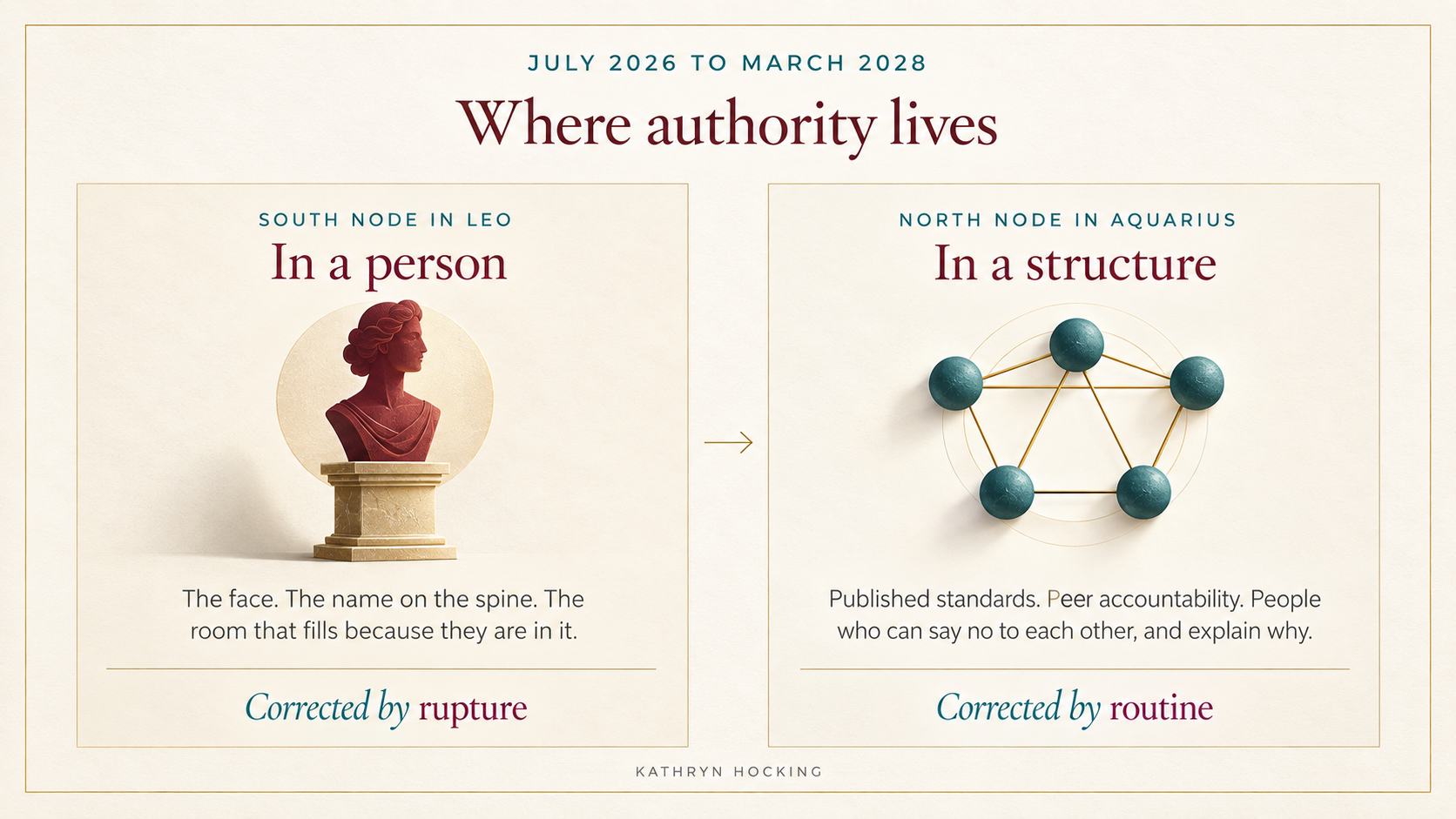
The South Node in Leo is the authority that lives inside a single person. The face. The name on the spine. The room that fills because they are in it. It is real authority, it has been earned, and it has organised how our field works for about forty years.
The North Node in Aquarius is authority that lives in a structure. Published standards, communities, bodies of work, peer accountability, groups of people who can say no to each other and explain why. Less glamorous. Considerably more durable.
And here is the part I would want you to sit with, because it explains why this is going to keep happening rather than resolve neatly.
Jupiter entered Leo on 29 June and travels with the South Node for the next year. Jupiter expands what it touches. So the personality-led model is having its loudest, most visible, most rewarded year at precisely the moment its foundation is being questioned. The big names are about to get bigger. The falls are going to get louder. Both at once, and for the same reason.
That is what a South Node under Jupiter looks like. Not a quiet fading out. A last, enormous, well-attended performance.
Why the Generational Frame Is the Wrong Read
The easy story is that the boomers are being pushed off their thrones by younger astrologers who will not tolerate what the field used to tolerate. There is a version of that story I could tell and it would do very well.
I am not going to tell it, for two reasons.
The first is that it is not accurate, and the months since July have proved it twice over. Plenty of established elders have handled this with more grace, more listening and more willingness to be uncomfortable than people a third of their age. And the sharpest criticism at UAC itself landed on someone who was not an untouchable elder at all. Age has not been the reliable predictor. Willingness to be answerable has, in both directions.
The second is that it loses the argument. The moment you make this about generations, the counter-argument writes itself, and it is already being written: this is ageism, this is a young mob tearing down its elders. Then everyone spends six months debating whether the response was fair and nobody talks about the thing underneath, which is how we distribute trust in this field and whether that system is fit for purpose.
What is changing is the basis of authority itself, from who you are to what you are answerable to. Some elders will make that crossing beautifully. Some newer astrologers will build the same pedestal for themselves within five years, because the pedestal is an alluring place to stand and youth is no protection against wanting it.
The Teacher I Never Checked
I was in the room.
Steven Forrest ran a conference from 2 to 6 August 2026, eight hours a day, and I was at it. The podcast had been out for more than a week, but I had never listened to it, because I do not actually follow him online. What reached us on the second morning was the fallout: the first statements from astrology organisations, and the argument that erupted online around them.
The timing was not subtle. The nodes had changed axis days before. The full moon at 6 degrees Aquarius had just passed. And the Sun, transiting Leo, was moving towards 20 degrees, where the first eclipse of the new cycle would land the following week.
I did not notice a bit of it at the time. I was too busy sorting through the many emotions I was having, including disbelief.
Some people left, and I understand why. Some had stronger reactions than I did, and perhaps clearer convictions. I stayed. I would love to tell you that was a principled choice. The truth is more human than that. I was in shock. I was already under a lot of pressure in my own life, and it had taken a great deal just to get myself there. I did not want to offend the people who had organised it. Some dear friends were there, people I had been looking forward to seeing. And I did not have the capacity to decide quickly. I have since understood that this is how my autistic nervous system meets shock. It slows right down, and it needs time before it can decide anything. So I stayed, and I listened, and I tried to be in the duality of it.
He had been on my shelf for years. I quoted him in my course modules. I recommended him to my students. I wanted the version of this where the man teaching in front of me made sense of it, sought to understand the harm and tried to repair it, even if he did not fully grasp his impact. I wanted to see humility.
But then the teaching did not sit right with me. Difficult material arrived without warning. The framing assumed everyone in the room lived the way he did. Small things, none of them a scandal, every one of them the same carelessness the podcast was.
That is what status does, and it is worth being precise about it, because the word people reach for is villainy and I do not think that is what I was watching. When nobody has been able to tell you no for forty years, you stop noticing your effect on the people in front of you. Not because you decided not to care. Because you have never once had to find out.
I left a day early. I was feeling heavy and deeply uncomfortable, disconnected from myself and my values.
But the real failure was mine.
I had never actually studied him. Years of recommending someone whose books I had read but whose teaching I had never heard for more than an hour at a stretch. I had let his status decide how quickly I respected him, and in all that time I had never once truly checked.
So there I was, finally doing the checking, at the worst possible moment to be doing it. And what I found was not the podcast. It was four days of the thing underneath the podcast.
That is the part that has stayed with me. What I needed to know had been available to me for years. The only reason I did not know it was that I had never invested the time to learn from him properly.
So What Do You Do With the Audit?
Back to you, and the list of names you have been going over in your head since July. That list is not cynicism and it is not disloyalty. It is the actual work of this transit, and it deserves better tools than anxiety.
Three questions to run over anyone you learn from, including me.
Is there anyone who can tell them no? Not a fan, not a student, not an employee. A peer, a board, a standard, a colleague who would still be their colleague afterwards. If the honest answer is nobody, that is information about the structure, not an accusation about the person.
What happens when they are wrong? Everyone is wrong. The tell is what comes next. Do they receive it, or do they explain it? An apology that arrives with a section headed “The Reality”, followed by describing yourself as “banished”, is doing something other than apologising.
Is the work separable from the person? Some teachers hand you a method you can use, test, disagree with and eventually improve. Others hand you an interpretation that only holds while you believe in them. The first survives their fall. The second does not, and neither does what you built on it.
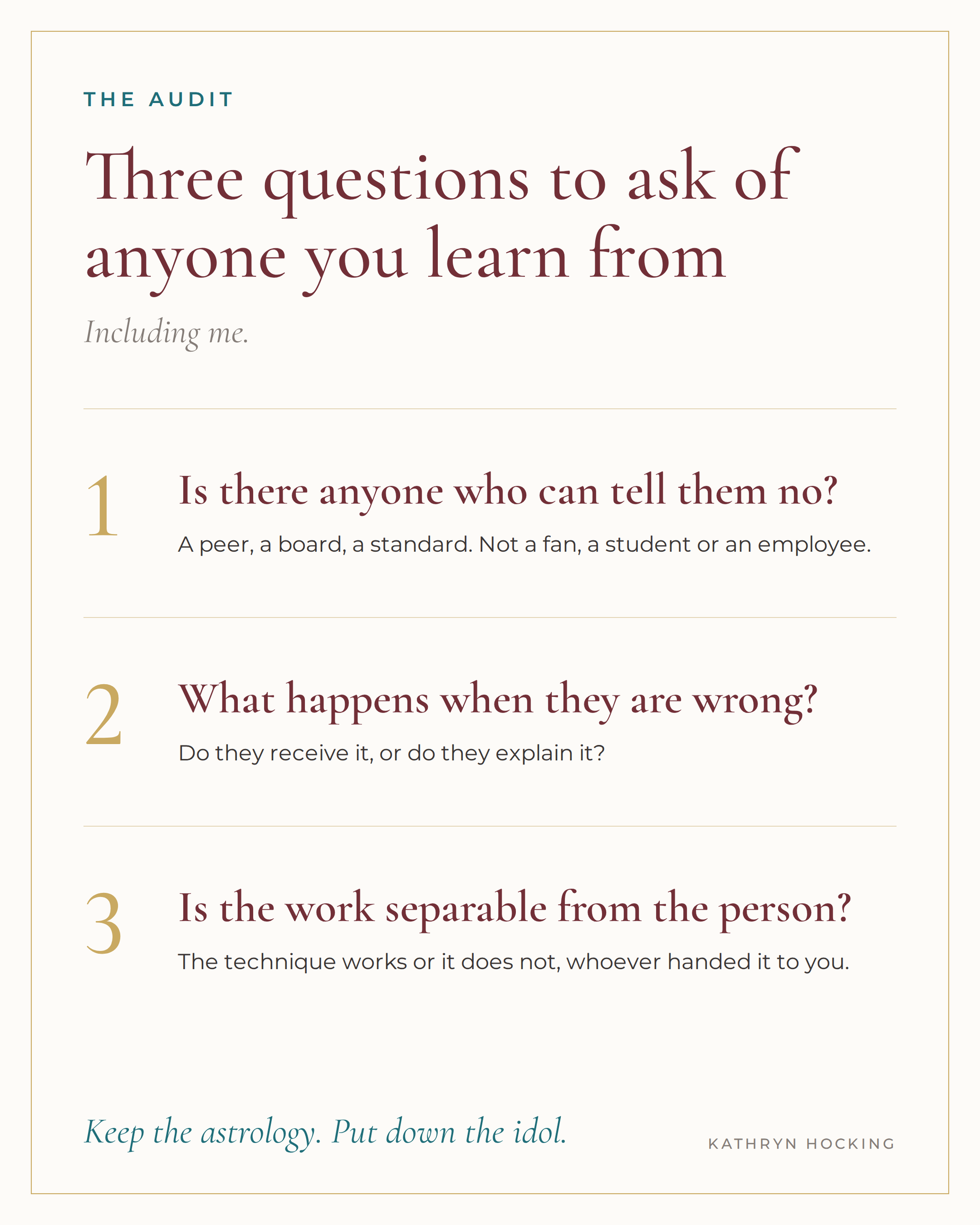
And one thing that is not on the list: whether you have to throw out everything they taught you. You do not. The technique still works or it does not, independent of who handed it to you. You are allowed to keep the astrology and put down the idol. That separation is the skill this whole transit is teaching.
The Uncomfortable Half
If you teach, mentor, certify, run a group or have people who quote you, this transit is not only asking you to audit others.
Ask who can tell you no. Ask what your work rests on, your method or your personality. Ask whether the people you elevate know why you elevated them, and whether you could write the criteria down if someone asked. Ask what would survive in your business, and in your students’ hands, if you were suddenly not available to defend it.
I run a certification and a mastermind. People put my name on things, and somewhere out there is an astrologer recommending me the way I once recommended him, on a reputation rather than on the work. That thought is useful to me. It is the reason my certification students are assessed against set criteria and marked by someone other than me.
I also know I have my own work to do here. There are still parts of my business where the only person who can tell me no is me, and writing this has made me look at them more honestly than I would have liked.
Building something answerable is harder and less flattering than building something that runs on being liked. It is also the difference between building a field and building a fan club.
The work is to build the kind of authority that does not need protecting.
If you run a small business on your own, none of this means getting a boss. Most of us built our businesses so that nobody could manage us like that, and that freedom is worth protecting. Being answerable looks smaller and more human in a solo business: peers who will tell you the truth, standards you have written down and published, clients who can raise a concern and know they will be heard, and the willingness to hear no when it comes.
What This Cycle Is Really For
Eighteen months from now, this field will look different. Some names will not be in it. Structures will be holding things that used to rest on a single reputation, some of them new, some of them already here and growing stronger. Published standards, directories with criteria you can read, peer bodies, communities with the standing to say no and the willingness to explain why. Unglamorous infrastructure, built by people whose names most of us will never learn.
That is the North Node in Aquarius doing its work, and it will happen with or without our participation.
The only real question is whether you spend the next eighteen months watching the falls, or building something that does not need one person to hold it up.
Start with the audit.
Kath
Sources
- Astrology University, statement regarding Steven Forrest
- United Astrology Conference, initial statement
- UAC 2026 board, official statement withdrawing Steven Forrest as a speaker
- Steven Forrest’s public response
- Judith de Haan, “When an Apology Becomes an Explanation”
- Bryan Winchell, “Steven Forrest and the Cultural River”
- Shellie Enteen, “Controversy Rages in the Astrological Community”
- Criticism of the UAC keynote, Threads
- A defence of Chani Nicholas, Threads
- UAC 2026, Speaker Selection process
- Chani Nicholas, Wikipedia