

The reading was brilliant. The ending left her with nowhere to go.
Thank you so much. That was exactly what I needed.
You’ve heard it hundreds of times. A client sits back at the end of a reading, a little teary, a little lit up, and tells you it changed something for her. You smile, you say something warm, and you close the way most astrologers close:
“Reach out if you ever want to go deeper.”
She says she will. She means it. And then you never hear from her again.
Not because the reading missed. Because the reading ended at a door with no handle.
The leak most astrologers can’t see
Since August, hundreds of astrologers and practitioners have taken my Growth Scorecard. It looks at four parts of how an astrology business is built: the client pathway, the offer structure, the invitation and the pricing.
The lowest score, by a clear margin, is the invitation. Around six in ten land in the bottom band, the one the scorecard calls built to keep you busy, not to pay you.
These are not astrologers who can’t read a chart. Many have years of practice, clients who rave about them and an inbox full of thank-yous. They do the work beautifully. They just don’t ask.
And so the pattern of one-off readings repeats: every session ends, the client walks away grateful, and the income starts again from zero.
Why we don’t ask
Most of us came to astrology to help, not to sell. Somewhere along the way, “don’t be pushy” became “don’t mention what comes next at all”.
Even as a business coach who believes selling is neither slimy nor sleazy, I’m still guilty of the lacklustre close. And it is lacklustre, because it shortchanges two people: you, and her. When you don’t tell her what her next step could be, you leave her on her own at the exact moment she needs you most.
We all hear that voice: don’t be too pushy, she’ll ask if she wants the next step. She usually won’t.
I know this one from the inside. Years ago I had a busy, in-demand readings business and still couldn’t reliably pay myself a salary. The readings were good. The business around them had no next step built in.
If you’re rejection sensitive, and many of us are, silence feels safer. If you never invite her, she can never say no.
What “contact me if you need me” asks of her
That one gentle sentence hands your client three jobs to do on her own, after she’s left the room:
- Work out what the next piece of work would be
- Guess what it costs, and whether you even offer it
- Decide she’s allowed to ask, then find the courage to email you
That’s a lot to give someone who is still taking in her chart. She is the person least equipped to design her next step. You’re the one who just saw the whole map.
Think about how you’d never read a chart this way. You wouldn’t tell a client a significant transit is coming next year and then add, “let me know if you’d like to hear about it.” You’d name it, explain what it asks of her, and tell her when to start preparing.
Inviting her into the next step is part of the reading. It’s the moment you tell her what comes next, and you’re the only one in the room who can see it.
The five-minute script
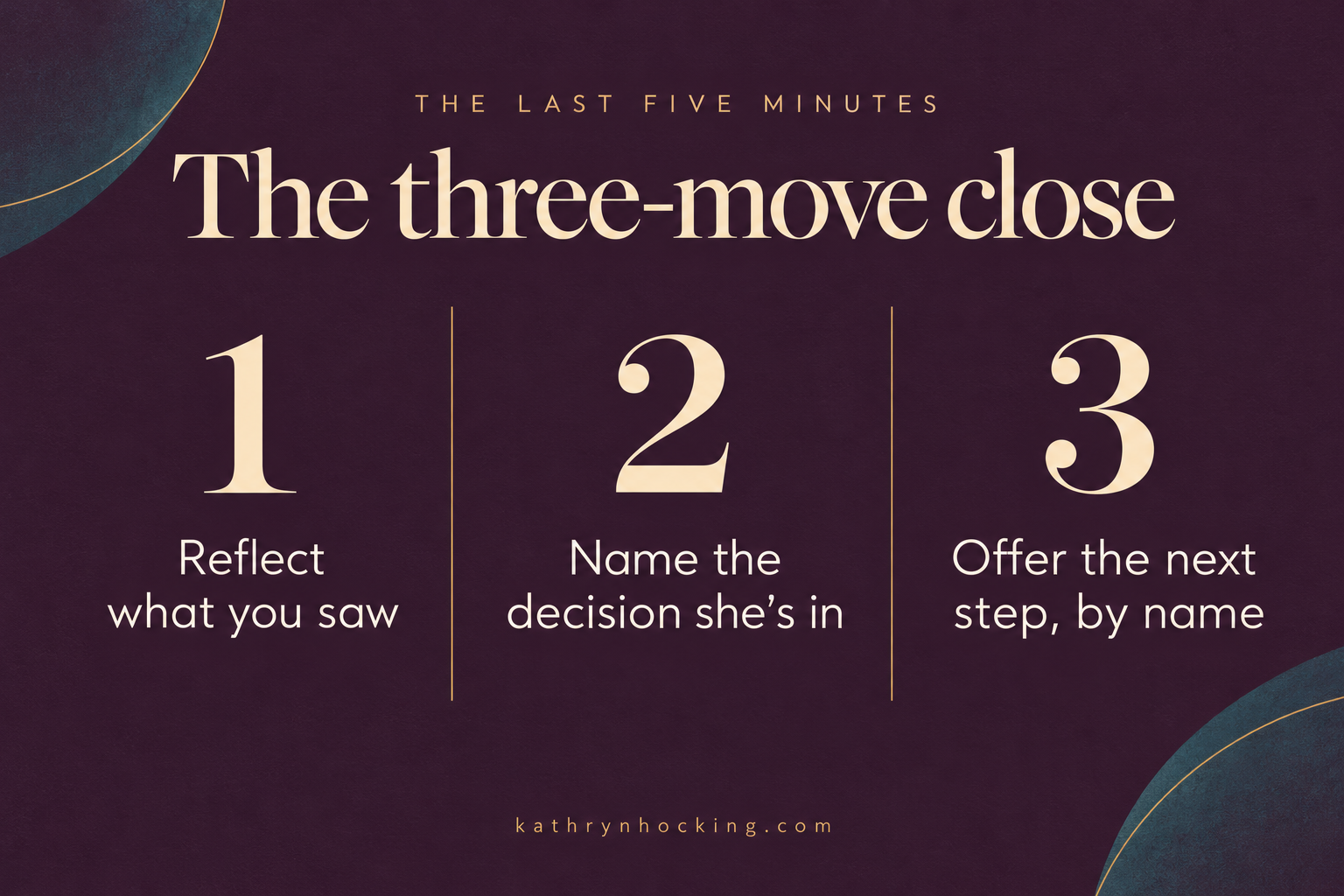
Leave the last five minutes of every session for this. Three moves, in this order.
1. Reflect what you saw. One sentence that names the heart of the reading, in her words rather than chart language.
“What stood out most today is that you’re ready to stop squeezing your creative work into the gaps around everything else.”
This tells her you saw her, and it sets up everything that follows.
2. Name the decision she’s in. Clients rarely book at a random moment. They come because they’re standing at a fork. Say it out loud.
“It sounds like the real decision in front of you is whether you give this the next six months properly, or keep it as a side project.”
Naming the decision turns a lovely conversation into something she can act on.
3. Offer the next step, by name. Not “reach out anytime”. A named piece of work, with a shape and a price you can say without flinching.
“If you’d like support with that, the next step is my three-month [your offer name]. We’d map the next six months against your chart and meet monthly to keep it on track. It’s [your price]. Would you like me to send you the details?”
Then stop talking, and let her answer.
When she says “I’ll think about it”
She probably will, and that’s healthy. Plenty of clients need to sleep on a decision before they trust it. All your job in the room asks is that the door is still open when she’s ready.
“Of course. I’ll send you the details tonight so you have everything in one place.”
The follow-up, within 24 hours
Send a short written note while the reading is still warm:
“Thank you for today. I loved seeing [the thing you reflected back]. As we talked about, if you’d like support with [the decision], the next step is [offer name]. The details are here: [link]. If now isn’t the right time, that’s completely fine, and your recording is yours to come back to.”
That’s all. No sequence, no chasing. One clear invitation, in writing, that she can come back to when she’s ready.
And if she says no? A no is information, and it says nothing about your worth. It tells you something about her timing, her budget or her decision, and that’s far more useful than the silence you had before.
You can’t invite her into something that doesn’t exist
This is where many astrologers stall. They try the script, reach move three, and realise there’s no next step to name. Just another reading.
A good deepening offer passes three tests:
- It picks up where the reading left off. The reading shows her the map. The deepening offer walks part of it with her.
- It has a name, a shape and a price you can say in one breath. How long it runs, what happens in it, what it costs. If you can’t say it simply, she can’t say yes to it.
- It feels like the obvious next step. She shouldn’t have to switch topics to say yes.
If you’re still calling yourself a reader, this is usually where you’ll feel it. A reader’s work ends when the session does. An advisor’s work has a next step built in. Even a simple three-month container with a name is enough to make the script work.
Find out where your business is leaking
Picture ending a session knowing the right clients will say yes to the next step, and your income no longer resetting every month. That’s what closing the Invitation Gap makes possible.
The invitation is one of four places an astrology business loses income. If you’d like to know whether it’s where yours leaks, or whether it’s your pricing, your offers or your client pathway, my free Growth Scorecard will show you which part to fix first.

Your clients already want to come back. Give them a door with a handle.